What Batteries Are Used in Medical Devices?
Primary cells: coin cells in meters and sensors
Many medical devices are built around a single, low-power function: a glucose meter, a digital thermometer, a pulse oximeter, an implantable sensor's external reader, or a small wireless sensor patch. These devices spend most of their life in standby, wake for a short measurement, and go back to sleep. Their power demand is measured in microamps for most of the day, and the battery must hold that quiescent drain for months or years without leaking or drifting in voltage.
For this class, primary (non-rechargeable) coin cells are the common choice. Lithium manganese dioxide coin cells dominate because they combine a stable open-circuit voltage, low self-discharge, and a flat discharge curve that keeps the measurement electronics inside their operating window until the cell is nearly exhausted. Silver oxide and alkaline chemistries appear in simpler or cost-driven devices, but their discharge curve is less flat and their shelf behaviour is more sensitive to temperature and humidity.
The mechanical part matters as much as the chemistry. Coin cells are held in a retention clip or a moulded pocket, and the contact pressure must survive drops, vibration, and repeated battery swaps without deforming. A weak clip produces intermittent contact, which a device reads as a fault. Contact plating, spring force, and the tolerance between the cell diameter and the pocket all belong in the mechanical drawing, not in a late-stage fix.
Environmental conditions also decide the chemistry. Devices stored in hot vehicles or shipped through humid climates need a cell whose seal and internal construction tolerate that without venting or swelling. The sealing gasket, not the active material, is often what limits a coin cell's real service life in a medical device. For sensors that must run through a cold chain, the low-temperature impedance of the cell should be checked against the sensor's peak current at start-up, because a cell that looks fine at room temperature can brown out the electronics on first wake in a cold store.
Rechargeable packs in monitors and mobile equipment
When a device draws meaningful current, runs for hours at a time, or is used repeatedly through the day, a rechargeable pack replaces the coin cell. Three device classes cover most of this ground.
Meters and handheld diagnostics that add a display, backlight, wireless radio, or printer draw far more than a coin cell can supply. A small lithium-ion or lithium-polymer pack keeps the device usable between charges and avoids the cost and waste of frequent cell replacement.
Portable diagnostics — handheld ultrasound, portable ECG, infusion pumps, patient monitors — need a pack sized around a real load profile rather than an average current. Peak draw during a measurement or a radio transmission can be many times the idle current, and the pack must deliver that peak without the voltage sagging below the device's cutoff. The load profile, not the nominal capacity, sets the minimum cell configuration.
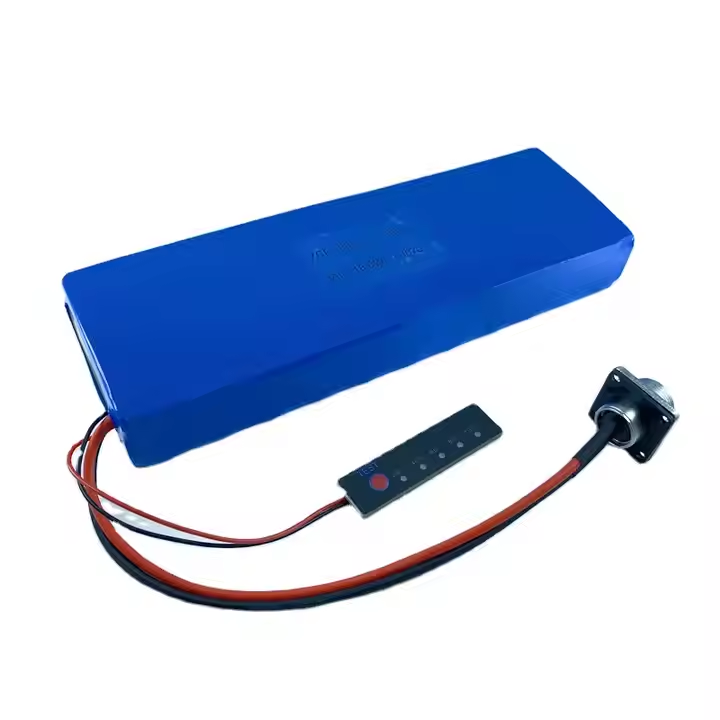
Mobile carts and robots — medication carts, imaging carts, nursing robots, sterilisation robots — carry larger packs and often a charge-and-run duty cycle. Here the design questions are thermal: how much heat the pack produces during fast charging and during peak motion, and whether that heat can escape the enclosure. Series count sets the pack voltage, parallel count sets capacity, and both are checked against the current profile and the physical space before the specification is written. Our 12V lithium packs show the configuration logic in practice; the same method scales up to cart and robot packs.
Rechargeable packs also need a protection and management layer: cell balancing, overcurrent and short-circuit protection, temperature sensing, and communication with the device's charger if the device manages charging itself. The pack and the host device must agree on charge termination and on what happens when the pack reports a fault. That agreement belongs in the specification.
Backup power inside medical devices
Not every battery in a medical device is the main power source. A backup cell or pack keeps volatile memory, a real-time clock, or a critical alarm alive when the main supply is removed or interrupted. In portable monitors and carts, a backup pack also lets the device shut down safely, log the event, and hold settings until the next power-up.
Backup duty is defined by three things: how long the backup must last, what current it must supply while doing so, and whether it is ever recharged. A memory-hold backup may draw almost nothing for years, which points to a primary cell with low self-discharge. An alarm or shutdown backup may draw a short, higher current, which points to a rechargeable pack kept topped up by the main supply or to a primary cell sized for that pulse.
The trap in backup design is assuming the main battery covers the backup function. It does not help when the main pack is removed for service or has been fully discharged. The backup path needs its own protection, its own low-voltage cutoff, and a defined behaviour on first assembly, when the backup cell may arrive partly depleted. Charge-accounting and a simple state-of-health check let the device warn service staff before the backup can no longer do its job.
Physical isolation matters too. Backup cells sit on the same board as the main electronics and often next to charging circuitry, so thermal exposure during main-pack charging has to be considered. A backup cell that is warm for hours every day will age faster than its datasheet predicts.
What documentation device makers ask for
Device makers qualifying a battery supplier ask for the same core set of documents, usually before the first production order and again whenever a cell or pack changes. The usual transport and safety set is UN38.3 test summary, IEC 62133 for the cell or pack, and an MSDS for the chemistry. Buyers also want the pack's specification sheet, a dimensional drawing, and the protection-circuit description. Depending on the device, they may ask for a declaration of the substances used and a statement on the RoHS status of the materials.
Configuration matters here because the documents attach to specific models, not to a supplier in general. UN38.3, IEC 62133 and MSDS documents can be confirmed and provided for specific models; tell us the model you are buying and we will confirm which documents cover it.
Two documented examples from our medical work show how the configuration drives the paperwork: a 12V 10Ah (3S4P) patient-monitor pack and a 12V 2.6Ah (3S1P) sickbed pack. Each is a distinct model with its own test summary and specification, and a device maker qualifying the first cannot assume the documents cover the second. Plan for the document set to be re-confirmed at every cell change, because a substituted cell invalidates the test basis even when the pack looks identical from outside.
Specifying a medical device battery
A medical device battery specification should start from the device's use cycle, not from a preferred cell size. Write down the load profile: idle current, peak current and how long it lasts, average current over a shift or a day, and the duty cycle. Then write down the environment: storage temperature range, operating temperature range, humidity, and whether the device is cleaned or sterilised between uses. Then write down the mechanical envelope and the retention method, including how the pack is inserted and removed and what happens if it is dropped.
From that, the chemistry and configuration follow. Primary cells suit low-drain meters and sensors; rechargeable packs suit monitors, diagnostics, carts and robots; a separate backup cell or pack suits memory-hold and safe-shutdown functions. Protection circuitry, charge control, and communication between pack and host are specified at the same time, not added later.
Bring the supplier in while the enclosure is still a sketch. Moving a contact, changing a pocket depth, or re-routing a charge path is cheap at that stage and expensive after tooling. If you are choosing between coin cells and a small pack, our coin cell batteries page covers the retention and contact side, and our medical device batteries page sets out how a pack project is scoped from the load profile. Send the load profile, the environment, and the envelope, and the specification can be written against your device.
Tell us about your battery project
Send your device requirements — voltage, capacity, current, space and quantity — and our engineering team will evaluate cell selection, configuration and battery management against them.