Lithium Polymer Batteries and Custom LiPo Packs
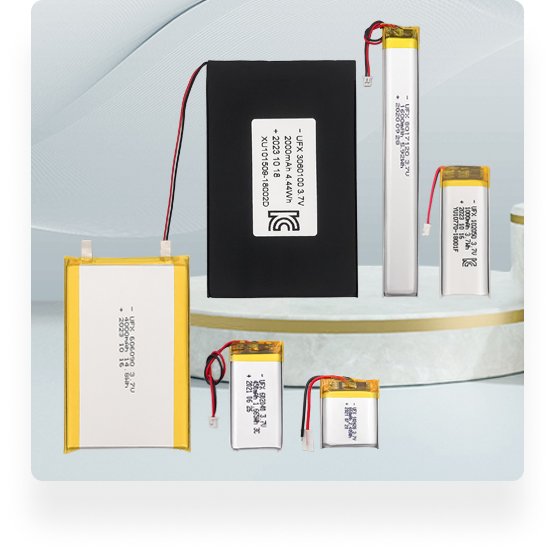
Why pouch cells: shape freedom for compact devices
A lithium polymer battery is built from pouch cells, and the reason to choose it is usually mechanical. Pouch cells are not held to a fixed can size, so the cell footprint can be planned around the product instead of planning the product around an off-the-shelf cell. For wearables, handheld instruments and compact consumer electronics, that difference often decides whether a pack fits at all.
A li polymer battery pack can follow a curved or irregular enclosure, sit in a thin cavity behind a display, or occupy leftover space that a cylindrical or prismatic cell cannot use. Shape and thickness are set within the cell maker's production range. The exact minimum thickness depends on capacity and is confirmed per project, so the usable envelope is agreed with the chosen cell rather than assumed at the start.
This shape freedom is not free of engineering work. A custom lithium polymer battery still has to meet your voltage, capacity and current profile, and the pouch format changes how the pack is supported, fixed and protected inside the device. That is why pouch packs are specified together with the enclosure, not after it. If your device is small and the space is awkward, pouch cells deserve a serious look; if the space is a standard cylinder, another format may serve you better, and we will say so.
Pouch construction also suits devices where weight and a low profile matter. The pack can be built as a flat assembly that spreads across the available area, which helps when height is the tightest dimension. We review the mechanical drawing and the current profile together before any cell is proposed, because a shape that fits but cannot deliver the load is not a solution.
Custom LiPo pack options (protection, leads, housings)
A custom lipo battery pack starts from your requirements list: device, application, available space, voltage, capacity, current, environment and target-market requirements. From there we evaluate cell selection, series/parallel configuration, protection and management circuitry, structure and communication options. Each item is recorded in the project specification, and options are confirmed in that document; not every model carries every option.
Protection circuitry is the first decision point. A LiPo pack can include a protection board that guards the cell group against overcharge, over-discharge and over-current, sized to the current your device actually draws. Where the device has its own charging and protection electronics, the pack circuit is matched to it rather than duplicated. The choice depends on the target market's safety requirements and on how the device is charged and discharged in use.
Leads and connectors are specified in the same pass. Wire gauge, lead length, connector type and the position where the leads exit the pack are agreed against your assembly drawing, so the pack drops into the enclosure without forcing the wiring. For packs that slide into a housing, the mechanical structure — frame, tape, shrink wrap or a formed shell — is agreed at the same time, because the pack has to stay in place through drop and vibration without stressing the cell tabs.
A custom lipo battery pack can also carry a thermistor or a fuse where the application calls for it. These choices are made during the evaluation step and written into the specification, so the sample you receive matches the pack you will order. To compare pouch cells with other small-format options, our page on coin cell batteries covers the alternative for very low-current devices, while custom battery packs shows how pouch packs sit alongside other chemistries.
Smart LiPo packs with fuel-gauge and communication options
A smart li polymer battery pack adds a fuel gauge and, where needed, a communication interface. The gauge reports state of charge and state of health to the host device, which matters when the product shows a battery percentage to the user or must shut down safely before the cells are exhausted. Communication options are evaluated per project; the protocol and the data the host can read are agreed with your firmware team, not assumed.
A smart pack is more than a gauge chip on a board. The gauge must be matched to the cell, the protection circuit and the current profile, and the pack structure has to leave room for the electronics. During evaluation we check whether the device needs a simple state-of-charge signal or a fuller data interface, and whether the host can act on the information. If the device has no display and no need for battery data, a smart pack may add cost without benefit, and we will flag that.
Environmental and target-market requirements feed into this section too. The documentation needed for the target market is checked at the verification stage, and the pack's communication and protection design is reviewed against those requirements. UN38.3, IEC 62133 and MSDS documents can be confirmed and provided for specific models — tell us the model you are buying and we will confirm which documents cover it.
The project flow is the same for smart and simple packs: requirements, evaluation, specification and drawings confirmed, then samples developed, then samples verified against the agreed test items, then production, packaging, quantities, delivery and acceptance conditions confirmed. If you are weighing a smart pack for a compact device, pack design support explains how the specification is put together.
Frequently Asked Questions
Can polymer cells be made in custom shapes and thicknesses?
Yes, within the cell maker's production range. Pouch cells are not restricted to a fixed can, so the shape and thickness can be planned around your enclosure. The practical limits depend on the cell size and capacity you need, so the exact envelope is confirmed per project against your drawing and current profile.
What is the minimum thickness for a custom LiPo pack?
There is no fixed number. Minimum thickness depends on the capacity the pack must deliver and on the cell maker's production range for that capacity. Send your available space and capacity requirement, and the thinnest workable build is confirmed for your project during evaluation, before the specification is written.
When should I choose a pouch pack instead of another format?
Choose pouch cells when height or shape is the tightest constraint and the device can be planned around a flat, formed pack. If the enclosure already accepts a standard cell and the current demand is modest, a different format may cost less. The decision is made from your space, current and volume requirements.
How do I start a LiPo project?
Send the device, application, available space, voltage, capacity, current, environment and target-market requirements. We evaluate cell selection, configuration, protection and management circuitry, structure and communication options, then confirm the specification and drawings before samples are developed. To discuss a LiPo project, include your drawing and current profile.
Tell us about your battery project
Send your device requirements — voltage, capacity, current, space and quantity — and our engineering team will evaluate cell selection, configuration and battery management against them.